At the end of June I took a taxi across New York City to JFK. A good friend accompanied me, knowing that this was a difficult journey; she helped me with my luggage, and with morale. We queued for an hour and a half at baggage drop. The air was hot and humid, the queue restive. I forked out $100 for being overweight (my suitcase, not me; happily they didn’t weigh me). I said goodbye to my friend with regret; I have known her 20 years and I will miss her.

So I am now in England, and time and change have been much on my mind.
A hitch with the flat I had been hoping to live in has seen me stay with friends and then, for a while, borrow a house from other friends; the latter have a well-stocked bookshelf. I had been meaning to read Virgina Woolf’s To the Lighthouse for 30 years but had wondered if I would find it dense and pretentious. When I moved in I saw they had a copy on their shelf. I had nothing immediate to do that day. There was now no excuse. I took a snap of the book on a table next to a glass of Sauvignon Blanc and posted it on Facebook, captioned: “I may need a glass of wine to get through this one.”

I beg to differ. This is a maddening book in some ways and no-one is obliged like it, or any book for that matter. But I didn’t need loads of wine to get through it. (I drank it anyway. But I didn’t need it.)
The book falls into two main segments, 10 years apart. The two main segments are before and after the first world war – but we know that only because one character has perished in it; Woolf mentions this only briefly, and says nothing else about the conflict. In the first, main, segment we see the Ramsays, a moderately well-to-do couple who spend their summers on Skye with their eight children and in the company of various house-guests. Ramsay is a philosopher who has, when younger, made a major contribution to metaphysics but whose reputation may be fading. Now in his early 60s, he seems to know this and needs constant reassurance and support from women, including his wife. But there is not one whit of evidence that he gives it to anyone else. And Ramsay is tactless as well as needy; the youngest child is excited that they will be taking a boat-trip to the lighthouse. Ramsay rather crushes him, and his wife, by saying brusquely that the weather will be bad and they shan’t go.
Yet it is not him but Mrs Ramsay who dominates this section, for she is far more interesting than her rather selfish husband. She has been a great beauty in her youth and is still striking, warm, affectionate and charismatic – but with a tendency to direct the lives of others.
This first segment is followed by a shorter, linking section, Time Passes, that expresses the passage of time. In it we learn of deaths and of the house, empty, losing its spirit.
In the second main segment, ten years later, Mrs Ramsay is dead and their eldest son has been killed in the war, while their eldest daughter has died in childbirth. The house has been neglected. But a few years later what is left of the family, and two of their friends, return. This time, Ramsay and the two youngest children do sail to the lighthouse. Before that, in a crucial moment, one of the house-guests withholds her emotional support from him. These two events bring a sort of closure; the children are no longer dominated by their self-centred father, and women no longer give him the reassurance he so needs but has done little to earn.
This reflects Woolf’s own life. She had lost her brother, her half-sister and then her father when she was still quite young. Most importantly, she had also lost her mother when she was just 13. Thus Mrs Ramsay was in fact a portrait of Woolf’s own mother, Julia Stephen, who – like Mrs Ramsay – had been a noted beauty; she had posed for the Pre-Raphaelite painter Edward Burne-Jones and the photographer Julia Margaret Cameron, amongst others. It seems she also had a tendency to organise the lives of others and was an avid matchmaker. This is Mrs Ramsay indeed, and the depiction of her is the key to the book, which turns on the effect she has on the people around her, and the way they feel about her after her passing – which Stephen did fairly suddenly, as Mrs Ramsay does in the book. This also brought family summers in Cornwall to an end (though nominally set in Skye, To the Lighthouse recalls those summers in St Ives; the lighthouse was modelled on the nearby Godrevy Lighthouse).
 |
| Virginia Woolf, left, and sister Vanessa in 1894, the year before the death of their mother, Julia Stephen (Photographer unknown) |
While time and loss are the main themes in the book, Woolf may also have wished to suggest that men dominate women and yet actually depend on them, suppressing their aspirations but also sucking them dry emotionally. This is seen not only in the relationship between the Ramsays but also in their guest, the artist Lily Briscoe, who is told by a fellow-guest that women can’t paint or write. Briscoe must struggle with her own lack of confidence but seems to decide in the end that it is her own feelings about her art that matter.
I also saw that Woolf was addressing a broader sense of loss, though it is not explicit; the world, and lives, lost through the First World War. So far as I know, she never said so; she doesn’t mention it as such anywhere in the book. We’re merely told that the eldest son has been killed by a shell fragment and that his death was instant along with that of 20 or 30 others. In that brief sentence Woolf may have subtly told us what To the Lighthouse is also about: not just loss, but the fact that in 1927 millions felt it. To be sure, this book expresses Woolf’s own very personal sense of loss. But the war is there.
I think I know. It isn’t pretentious, but it can be dense. That is a function of the way it is written. As a rule, a good writer will show, not tell. What is striking about To the Lighthouse is that Woolf completely breaks that rule, taking us inside the characters and unspooling their inner thoughts. A friend who lectures in the arts at a major US university, and has taught this book and others by Woolf, reminds me that this is common to many writers, especially when telling stories from multiple viewpoints. “Do we accuse Henry James, say, of telling not showing?” she asks me. It is a fair point. But Woolf does take this quite far. It works, the way breaking any rule might work provided you break it hard enough. It also makes this book a little hard, at times, to read. But it is one of the keys to its poignant nature.
Another reason may be the fact that this book was, for Woolf, autobiographical and deeply personal, and is anchored in characters that she herself knew. This may also have irritated some readers, as it can seem self-indulgent; surely a good novel should say something about broader human experience?

I suppose that if everyone likes a book, no-one really loves it. And when I made that Facebook post there was one dissenting voice, from my lecturer friend. The book was, she said, “exhilarating. And profoundly moving – on time, perception, loss, art. It is a book that never leaves me.” I think I at least partly agree. To the Lighthouse is not, in the end, a sterile or pretentious literary experiment. On the contrary, it is surprising for its gentle depiction of love and regret and its understanding of grief.
I did not need the brandy.
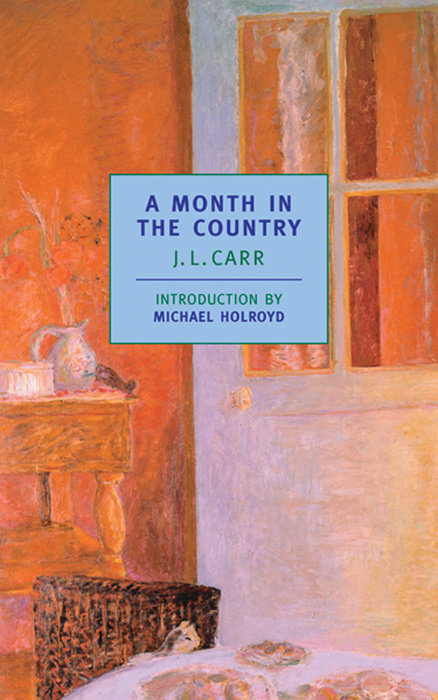
So to another book I found in the same shelf: J.L. Carr’s A Month in the Country.
A Month in the Country begins on a wet day in the summer of 1920. A young man arrives in the Yorkshire village of Oxgodby to execute a commission. A wealthy parishioner has left a bequest to the church on the condition that a medieval doom-painting high on the chancel arch, long whitewashed over, is uncovered. The young man, Birkin, is the restorer. Over the summer he will reveal the painting. He will also find a sense of peace in the village, and will start to recover from the damage inflicted on him on the battlefield at Passchendaele. But he will also fall in love, and face a decision. Nearly 60 years later, he recounts that summer in Yorkshire and what it meant to him, and remembers the world of the 1920s, now vanished.
I had expected a dreamy, elegiac book, but it seemed at first that I was going to get something more realistic than that. It opens in the rain as Birkin walks down to Oxgodby soaked to the skin and gets a cool welcome from the vicar, who he knows at once he shan’t like. And yet this book is elegiac, a picture of the countryside 100 years ago and a way of life that has likely largely gone, with horses and carts hauling people to Sunday-school treats and harmoniums in the chapels. This could have been very hackneyed or contrived, or come across as cloying nostalgia. It doesn’t, because Carr’s language is simple and elegant; not one passage is over-written, so that at the end the sense of a lost world, and long-ago love, strikes one suddenly and with some force. It’s something I’ve only seen done this well once before, by J. B. Priestley in his own masterwork, Bright Day.
Sometimes books can be a source of solace at a time of change and worry. These two were.
If you liked this…
More from the haunted wing of 20th century literature
The Butler Did It! ...Or Did He?
Who, really, were the Queens of Crime? A look back at Agatha Christie, Dorothy Sayers and their rivals
The Monkey’s Benison: Rumer Godden and Imperial India
A novelist, best known for Black Narcissus – but who also wrote dazzling memoirs
Diana Athill: Self-Scrutiny, and the Writer’s World
An editor and writer who held up a mirror to herself, and to the human condition
Crime on the Side
The oddest people moonlight as crime writers – and sometimes they’re rather good. A famous journalist and a Poet Laureate were among them
If not us, who? If not now, when?
Courage and tragedy at the heart of the Third Reich
On Whether He Warned Us
The long, fatal journey of Stefan Zweig
When the Best Lack All Conviction
Two women who didn’t: Rachel Corrie and Heather Campbell
War Tour: The Incredible Journey of Ève Curie
Marie Curie’s youngest daughter did not – quite – win a Pulitzer. But she left a compelling account of World War Two and the people who fought it
The Great War in Modern Voice
Written nearly 60 years after the war ended, Eric Hiscock’s The Bells of Hell has a life and freshness that you won’t find in the classic memoirs
Around the Horn Before the Mast
Jack London, Alan Villiers, Eric Newby: Great books from the last days of sail
Screw the Donah’s Groinies
A likeable romp through the fairgrounds of prewar Britain
Before Yossarian
Two powerful books from the First World War
And an incursion into the 21st century…
To Pagford, from Bradford
J.K. Rowling’s first post-Potter, The Casual Vacancy, divided the critics; but what mattered was what it tells us about ourselves. Two novels that shone a light on Britain in 2013 – and in 1913
Love in the Time of Brexit
The 2016 Brexit referendum divided Britain along class lines. Why? Two shrewd, gripping novels on Brexit, class and the dynamics of division


