Showing posts with label books. Show all posts

Friday, 31 July 2026

Short fiction: The Man Who Lost the Plot

 cardboard character

“Actually yes, my father did teach me something,” said Bernard.

Diana sat up in her chair. “He did?”

“Yes,” he replied. He looked at her, but his gaze was unfocused. He turned away, towards the Mediterranean that washed the cliffs 100 feet or so below the stone balustrade of the terrace; its surface glittered in the afternoon sun.

He was in his 70s, and rather thin; his beard was grey, his flyaway hair patchy, his eyes a very pale blue. He was slumped back in his chair, but the latter was high-backed and capacious, with thick armrests that kept him upright despite the amount he had drunk. He wore a faded Hawaiian shirt in orange-and-lemon hues, and a gold chain around his neck that rested on the white chest hair visible at the shirt’s open neck. We must seem an odd couple to the other diners on the terrace, thought Diana. This louche being Bernard, and herself – a trim blonde in her late 30s, dressed for the London office she had left early that morning; a smart green cord blazer and white blouse that flattered her figure and a dark skirt that ended not too far above the knee.

Delfi de la Rua/Wikimedia Commons

“What did he teach you?” she asked. She glanced at her recording device to make sure it was working.

“It was a problem,” said Bernard. “That he had with Dexter.”

“Really?” asked Diana. Dexter’s Sacrifice. The novel that had nearly won the Booker. Though she had never quite been convinced by the ending. But the world had disagreed, and the book had brought Sir John Coulter the Nobel Prize for Literature. The Nobel committee had talked of “the profound humanity… of his depiction of the ultimate sacrifice by a man driven by the nobility of the human spirit.”

I think there is a story here after all, she thought, and the hairs stood up on the back of her neck.

*

“You’ll get nothing from his son,” the Arts Editor had told her the day before as they sat in his glass-and-steel office in Canary Wharf. “Remember, his own books were not well received. Compared with his father, Bernard has been a failure.”

“I shall try flattery,” said Diana.

“He’ll see straight through it. He must know what a flop his own career was in comparison.”

“Well, I should try,” said Diana. “We must mark Coulter senior’s 100th. How is he seen, 30 years after his death? Is he still read, and all that? – yes, we know he is. What does his son remember?”

“Also you get a trip to Italy… er, what’s the name of the place where he lives?”

She told him. He chuckled.

“That’s where aristocratic German perverts went in the 1890s, to take pictures of bronzed naked teenage boys,” he said.

“So it was. Well, if I don’t get anything out of Bernard, I can always do a feature on its history, and we can illustrate it with a tasteful selection of filthy daguerrotypes.”

“I wonder if that might pull in more punters, actually,” said the Arts Editor.

*

“So what was the problem he had with Dexter’s Sacrifice?” she asked.

She wasn’t sure he had heard, but after a moment he began to speak.

“I was about 16,” he said. “We were living in Hampstead. Dad wasn’t an enfant terrible any more, you see. He’d made some money by then. And he had this paper job as an advisor to the Arts Council.”

“That’s right,” said Diana. “Surprising for a rebel.”

“Not really,” said Bernard. “That is the way the Establishment does it in England, isn’t it? If you tilt at windmills too often, they give you one of your own to shut you up.”

“I suppose so.”

“Anyway,” said Bernard, “my father was in his 50s then. He wrote in an office that had French windows onto the garden. It was early summer and they were open. My stepmother was out somewhere, as she usually was; actually she was shagging a Tory MP but I didn’t know that at the time, though I expect Father did. I was sitting on the patio, revising for my French O-level. I failed it of course. He was very angry about that…. It was mid-morning and he was writing. He had this rule. Always write at least 500 words before lunch. He knew he wouldn’t after lunch, you see. Because by then he drank.”

You would know about that, thought Diana. Before lunch, they had gone through a bottle of Lacryma Christi, which Bernard appeared to drink as an aperitif. During lunch they had dispatched a bottle of Aglianico de Vulture. (“Vulture goes well with grey meat,” he had quipped, nodding towards her plate of vitello tonnato.) Bernard had drunk most of this; he had now drunk several Avernas. Diana drank little while working. She now cradled a limoncello.

He seemed to drift off, and Diana prompted him.

“So what happened about Dexter’s Sacrifice?” she asked. He seemed to jerk back to life.

“I suddenly heard my father roar out: ‘Damn! Damn! Damn!’ And he came through the French doors almost violently. ‘Dexter does not work! He does not work! He would not do it!’ And he stood there on the patio, looking down the garden. He took no notice of me.” Bernard hesitated for a moment. “But then, he never really did.”

That is what his biographers say, thought Diana. Out loud she said:

“And did he say anything else?”

“Not at first. But after a moment I said, ‘Father, why doesn’t Dexter work?’ And he looked around as if he had just noticed me and said: ‘Dexter is to perform this supreme sacrifice, this monstrous act of self-abnegation. But he would not do it. I am writing a book about an unselfish act by a selfish man; an act of redemption. It is supposed to warm the cockles of the reader’s heart. But damn it all, the man is a shit. I know that he would not do it. Do you hear?’ And he unclenched his fists and looked down at the grass and said, ‘He would not do it. We would not do it. We are all shits.’

“And then he turned and strode back through the French doors.”

“He wrote it that way anyway,” said Diana.

“Yes,” he replied.

“I asked you if he ever taught you anything, any piece of wisdom that has helped you write yourself,” she said, “and you said yes.”

“He taught me two things that day,” said Bernard. “First, that a character in a narrative must behave in character. Otherwise, they are cardboard. The book probably won him the Nobel. But it never worked, you see. It never worked.”

“I know,” she said. “I read it for A-Level English. It didn’t work.”

“The character lost the plot, you see,” he said.

“Actually,” said Diana, “it was the other way round. What was the second thing you learned that day?”

“That we are all venal,” said Bernard. “He needed to finish the book. It did not work. But his publisher was waiting. So that must not be allowed to matter.”

DCRJSR/Wikimedia Commons

He looked at her, his eyes unfocused.

“But he was better than me,” he said. “I was never any bloody good, was I?”

“People read your books.”

“For form’s sake, to see if I was like him.”

“Do you still write?” asked Diana.

“No.”

“What do you do, day to day?”

“I collect daguerrotypes,” said Bernard. “Have you heard of Wilhelm Freiherr von Westofen?”

“Was he one of the aristocratic perv – er, photographers who came here in the late 19th century?” asked Diana.

“Yes,” replied Bernard. “Although everyone calls these old pictures daguerrotypes, by then they were using glass negatives and paper prints.”

“Weren’t some of these guys …dodgy?”

“Judge for yourself,” he said, and took out his phone. He jabbed it a few times then handed it to her, saying: ”Here. Scroll down.”

So she did. She looked up at him.

“These boys look very young. Didn’t the locals object?”

“No. He was far too wealthy,” said Bernard. “And he paid off the local men of honour. Wouldn’t work now. Anyway, most of these pictures were thought lost. Destroyed, you see. By Fascists and priests. In a fit of morality.”

Diana looked at the pictures and wondered if the priests and Fascists might have had a point. She handed back the phone.

“You’ve got your story now, haven’t you,” he said.

“What?”

“You came to get something on my father. You didn’t really come to see me. But I can be a story too, can’t I? I’m a failed writer and a pervert who collects dirty pictures of boys. In the name of art history, naturally.”

He took a gulp of Averna.

“Why don’t you do that?” He continued. “Poignant story of famous writer’s failed son. The son who lost the plot.”

He was looking at her with what she suddenly realised was pure, unalloyed hatred.

“Why would I wish to do that to you?” she said.

“Because you do. Because you all do.” His eyes glowed with malevolence.

And then he cried.

It was a quiet time of the afternoon but a few tables were, like theirs, still occupied from lunch. One or two people looked their way. She looked her bag for a tissue and found she hadn’t one.

Then he fell asleep.

She sat with him for five minutes or so, wondering if he would wake. He didn’t, and she looked around at the sea, now sparkling against the sun as it swung round to the west. At length she stood and went inside, where she found the head waiter and asked for the bill. She paid, then took a €50 note from her purse. “I wonder if you might do something for me?” she asked.

The head waiter nodded politely.

“When Mr Coulter wakes up, would you arrange for a taxi and ensure that he returns home safely?”

“Yes, of course, Signora.” He took the note. “I have done so before. I shall call his housekeeper; she is my cousin.”

“Excellent,” she said. “Thank you.”

She walked back to her hotel through a series of small, shady streets and piazzas; most Italians were resting at this hour in summer, and there was almost no-one about, the shutters drawn across many windows. The occasional motorino hummed past and that was all.

At the hotel she sat at the small round table on her veranda and began to type her story. By seven o’clock she had it, at least in outline. Coulter Knew Dexter “Did Not Work”, read the headline. Knew Nobel book was flawed, says son.

She listened to Bernard’s last rant on her earpiece.

At length she pressed the Save button and took a Peroni beer from the minibar. The sun was sinking over the sea. She watched it for a few minutes, then took out her phone and composed a text.

Please report on status of joint projects

She smiled, and put the phone down. A moment later it buzzed in reply.

First joint project dormant

She replied: Good. Second joint project?

Bedtime strop earlier. Is now brushing teeth in compliance with project management

She chuckled.

How trip? How Bernard? 

Has lost plot very sad

Oh. Sorry

Hate job sometimes

Understand. Large gin waiting here

😊😊😊Love to joint projects

She put her phone down. No, she thought. I shan’t write about Bernard.

She swallowed some beer, and watched as the rim of the sun sank below the horizon and the sea began to darken.


More short fiction from Mike Robbins

The Long Road from the Black Death A history lecturer retires
Who Killed Walter Williams? Don't ask, even now
A Difficult Life When the world dislikes your birth
Come and See the Chickens A rather English love story
In Search of a Plot  Be careful. Elspeth may put you in a bacon slicer
A Question of Character Pity the nation...
The End A gun on a brownstone roof
The Last Time A figure skater leaves the ice
After the Flood An end? Or a beginning?
Remembered Time The past is a dangerous place
A Train Journey One's sister comes to visit
Time After Time When you have to warn the children
Fashion Wokeness and subversion. With style
A Time of Darkness History doesn't repeat itself. But it rhymes
Another Time A tear in the fabric
Evolution The world is turning
When Time Stands Still A hurricane lashes Pershing Square
Parallel Worlds Heat pumps and lentils. And a nice glass of Marsala
A Man for All Seasons Net zero. The Stranger's Bar. And a three-line whip
A History Lesson Why do we study it? So we can spot it happening
The Creatives Meeting a tech bro
Cold Everything is cold here
Homecoming A sort of love story
Solitude A Cold War memory
Rhodri Hactonby's Maps A question of social geography
Hiraeth A yearning…
Strange Places A spirit in the sky 
A Sideways Journey Things might have been different
Displaced Encounter on E94th Street
Belonging Do you? Where?
Leaving Home A house has memories

Mike Robbins is the author of a number of fiction and non-fiction books. They can be ordered from bookshops, or as paperbacks or e-books from Amazon and other on-line retailers.
Follow Mike on Twitter and Facebook.

Friday, 19 May 2023

Crime on the side

Crime writing is fun, but don’t give up the day job... A look at two vintage detective stories by men who didn’t

When I was a child my parents used to like a good thriller or crime story on TV, especially on a winter’s night. “See what’s on tonight?” my mother would say, as my father dutifully opened The Times at the telly page; and then she would almost always, say, “I do hope there’s a good murder.” Back then, that meant a series such as The Saint, adapted from the stories of Leslie Charteris and starring Roger Moore, then in his 30s. Or, a little later, The Expert, in which Marius Goring played a forensic pathologist. There were many more, including the odd American import.

Like my mum, I do enjoy a good murder. Committing one oneself means lots of messy paperwork and there are ethical questions, so I prefer to read a good crime novel. A year or so ago I wrote a piece about the Golden Age of Crime, focused on the four famous Queens of Crime – Agatha Christie, Dorothy Sayers, Margery Allingham and Ngaio Marsh. But I mentioned that there were a host of others, often now forgotten – some with good reason, but others still well worth the read. A recent rummage round a Norwich bookshop (The City Bookshop, since you ask; others are available) turned up a selection. Some had been ‘rediscovered’ and put out under a modern imprint, but one of those was very disappointing; I could not read more than 20 pages. However, there were also some original Penguins in their green-and-white covers, very old, very pre-loved and in one case stuck together with Sellotape. These proved rewarding.

First, A Question of Proof by Nicholas Blake.

*

 A Question of Proof is a classic Golden Age of Crime story. If you like Agatha Christie & Co., you may well enjoy this.

Written in 1935, it is set in an English prep school. It’s summer and the school’s Sports Day has rolled around. Sometime between lunch and tea, one of the pupils, a ghastly little tick called Algernon Wyvern-Wemyss, meets with a most unfortunate end. Suspicion rests on the members of the staff common-room. Was it Evans, who is carrying on with the headmaster’s wife, and may have been blackmailed by the boy? Wrench, who is doing likewise with one of the maids? Either could be ruined if rumbled (this is the 1930s). Or was it Gadsby, the prodigious drinker? Or Sims, who cannot keep order? Evans’s eccentric friend Nigel Strangeways is brought in to find out.

It’s the first of many outings for Strangeways, who was to feature in most of Nicholas Blake’s detective novels, of which there were 20 in all. As many people will know, “Nicholas Blake” was a pseudonym for C. Day Lewis; the future poet laureate was himself an impoverished prep-school schoolmaster at the time and wanted to earn some money from detective fiction without risking his reputation as a poet. He proved quite successful; the books were never quite as popular as (say) Agatha Christie’s, but they did do well and are still read.

It’s easy to see why. A Question of Proof seems a bit old-fashioned now, but it’s well-written and well-paced and the characters very well-drawn. And having gone to a prep school myself, I think he catches the atmosphere. No-one mourns the dead pupil; for the other boys, his sudden death is the occasion not for sadness but for excitement and speculation, and Day Lewis catches this callousness rather well. The chaos in Sims’s classroom is realistic; there were always teachers like that who could not control their pupils. There’s also a surprising whiff of radical politics, though it’s very subtle – Day Lewis was on the left most of his life and at the time this was written was actually a member of the Communist Party. One wonders how he really felt about teaching in a place like this.

C. Day Lewis in 1936 (Howard Coster/
National Portrait Gallery)

I am not sure how I feel about Strangeways. He is somewhat contrived, with his carefully crafted eccentricities such as an addiction to tea, in huge quantities, throughout the day – though some people do have that in real life (the late Tony Benn was an example). Still, most writers of detective fiction have such a lead character, a cipher through which the reader follows the crime being solved. They are often given an odd backstory or a pattern of eccentric behaviour, and this is consistent from one book to another. That consistency means readers know what to expect, and will buy the book. Christie of course had Poirot; Sayers had Lord Peter Wimsey; P.D. James had Adam Dalgleish. But the writer must ensure that their investigator acts true to character, and that – especially in later books – their eccentricities do not become so hackneyed that they become a caricature of themselves.

A number of “Nicholas Blake’s” detective novels are still in print, including at least three or four for Kindle. A Question of Proof, the first, was published in 1935 and the last, The Private Wound, as late as 1968. By then Lewis was Poet Laureate, having been appointed at the start of the year. It is one of four “Nicholas Blake” novels that doesn’t feature Nigel Strangeways. The other 16 do.

Detective fiction does seem an odd departure for an intellectual like Lewis. At the time A Question of Proof came out he was 31 and had published his first collection of poetry 10 years earlier; he was an associate of W. H. Auden and was strongly influenced by him as a poet. (Nigel Strangeways is said to have initially been modelled on Auden, though he acquired a more distinct character in later books.) Patrick Maume, writing in the Irish Dictionary of National Biography, says that Day Lewis had reviewed numerous detective stories for the Spectator and thought he might as well have a go himself. It is also said Day Lewis needed the money. Whatever his motives, the identity of “Nicholas Blake” soon became known; the board of Cheltenham College, where he was teaching, were concerned and he had to assure them A Question of Proof was in no way autobiographical. (The board were already displeased by his membership of the Communist Party.) 

As to the Blake novels themselves, it may seem that they were meant purely as entertainments but this was not entirely so. “Day Lewis always made it clear that he did not regard the Nicholas Blake novels as serious works of art, but that they should not be dismissed as purely commercial,” says Maume, adding that Day Lewis used the books to explore certain morbid psychological states. There are also political overtones; The Smiler With the Knife (1939) revolves around a fascist conspiracy, very topical at the time. Maume says the film rights were optioned by Orson Welles. Moreover crime fiction might have been a sideline for Day Lewis, but it was a jolly successful one. One of the novels, The Beast Must Die (1938), sold some 430,000 copies, according to Maume. It was filmed in 1969 by Claude Chabrol, and is still in print. 

*

During the war Day Lewis was in a long and troubled affair with the writer Rosamond Lehmann. He was thus a frequent visitor to her cottage at Aldworth, on the Berkshire Downs west of Reading. There he will have become acquainted with the journalist Anne Scott-James – then women’s editor of Picture Post – who owned the cottage next door. He will thus also have known Scott-James’s then husband, Macdonald Hastings, who also worked for Picture Post, in his case as a war correspondent. After the war he too decided to try his hand at crime fiction. Cork and the Serpent (1955) was one of several detective novels he produced between 1951 and 1966.

The books have an original premise; instead of a detective or private investigator, they feature one Montague Cork, the head of a large London-based insurance company. Now and then, should a claim seem doubtful or fraud possible, he will investigate personally. He has thus become something of a sleuth. One evening he is walking down Mayfair’s Cork Street when he is accosted by a lady of business. She is taken aback by Cork’s response, which is to examine the brooch she is wearing; how did she come by it? He has realised that it fits the description of a valuable jewel that has been reported to his company as lost.

However, it turns out that not one but two clients have reported it as such. So whose was it? One of the two is clearly lying. The eccentric playboy Maharaja of Lumphur? Or the Berkshire racehorse owner and peer Lord Pangbourne? Before Cork can dig further, something most regrettable happens to the Maharaja. Cork decides to speak to Pangbourne and glides off down the Great West Road in his Bentley. The action takes place mainly on the Berkshire chalk downs that to this day are an important centre for the horse-racing industry. The world of horse racing is an important backdrop to the story, as are the rural locations.

It all sounds a bit genteel. It isn’t; the folks in this book do some quite unpleasant things to each other, there are well-drawn, colourful characters and, as in all the best detective yarns, you do become invested in the story and want to guess who the villain is before Cork does. There is also a surprising final scene involving a Royal garden party. Now and then the plot does get contorted, and it was never quite clear to me exactly how the streetwalker, Carmel, came by the brooch. But it’s all good fun. Moreover Hastings’s depiction of Carmel and of the Indian characters seems old-fashioned today but was probably liberal for its time (although Macdonald Hastings himself was not; he held very conservative views).

The rural and racing themes are not surprising, as author Hastings was a great lover of country life and of country sports. According to his son, the journalist and historian Sir Max Hastings, he spent a great deal more than he could afford on the latter, keeping a collection of superb shotguns. He had been quite a distinguished war correspondent; his more dangerous assignments included trips on motor torpedo boats and a bombing raid over Germany in a Short Stirling, the crew of which were killed the following night. His son wrote in a family memoir (Did You Really Shoot the Television?, published in 2010) that he was probably quite reckless. After the war he edited the prestigious Strand Magazine, and when that folded in 1950 he started a magazine on the countryside and country pursuits, Country Fair (this too lost money).  It was about the same time that he started writing detective novels. His character, Montague Cork, was based on a real insurance magnate who Hastings knew, Claude Wilson, head of the Cornhill Insurance Company. History seems to record little of Wilson, and Hastings himself once said that nothing so exciting had happened to Wilson in real life.

There were five Montague Cork novels. In Sir Max’s view, Cork and the Serpent is actually the weakest of them; it draws on Hastings’s knowledge of racing, which was not as great as he supposed it to be, according to his son. Neither, he adds, was his father really familiar with the aristocracy, and this also shows. Critic Daniel P. King, writing in Twentieth Century Crime & Mystery Writers (1980), calls it a “slow moving tale with much muddling about”. He also states that the Cork novels “range from the trite to the noble”. This might be sweeping. To be sure, Macdonald Hastings was not Agatha Christie or Dorothy Sayers. Detective novels, for him, were a sideline in a busy life. Still, the Cork books sold well; and I thought Cork and the Serpent much better than King judged it to be. If it is the weakest, then the others might be well worth reading.

In Did You Really Shoot the Television?, Sir Max is often highly critical of his father, who was bad with money, had very right-wing views and was monumentally tactless. But he had a varied and successful career in journalism, and later in broadcasting.  And Montague Cork, says Sir Max, was a “delightfully original fictional creation”; he praises, too, the countryside descriptions in the books, especially in Cork on the Water and Cork in Bottle. I would like to read the rest.

Not all vintage crime fiction is worth reading. Although some books are unjustly neglected, others are neglected all too justly. But Nigel Strangeways and Montague Cork do deserve our time. As it happens, both were written by men who had remarkable lives of which crime fiction was but one part. So if, as crime writers, both are still worth reading, maybe that is not a coincidence.


If you liked this…

More from the haunted wing of 20th century literature

The Butler Did It! ...Or Did He?
Who, really, were the Queens of Crime? A look back at Agatha Christie, Dorothy Sayers and their rivals

The Monkey’s Benison: Rumer Godden and Imperial India
A novelist, best known for Black Narcissus – but  who also wrote dazzling memoirs

Diana Athill: Self-Scrutiny, and the Writer’s World
An editor and writer who held up a mirror to herself, and to the human condition

On Change, War and the Passage of Time
Don’t be afraid of Virginia Woolf – or J.L. Carr. Two beautiful books written in the wake of the First World War

If not us, who? If not now, when?
Courage and tragedy at the heart of the Third Reich

On Whether He Warned Us
The long, fatal journey of Stefan Zweig

When the Best Lack All Conviction
Two women who didn’t: Rachel Corrie and Heather Campbell

War Tour: The Incredible Journey of Ève Curie
Marie Curie’s youngest daughter did not – quite – win a Pulitzer. But she left a compelling account of World War Two and the people who fought it

The Great War in Modern Voice
Written nearly 60 years after the war ended, Eric Hiscock’s The Bells of Hell has a life and freshness that you won’t find in the classic memoirs

Around the Horn Before the Mast
Jack London, Alan Villiers, Eric Newby: Great books from the last days of sail

Screw the Donah’s Groinies
A likeable romp through the fairgrounds of prewar Britain

Before Yossarian
Two powerful books from the First World War

And an incursion into the 21st century…

To Pagford, from Bradford
J.K. Rowling’s first post-Potter, The Casual Vacancy, divided the critics; but what mattered was what it tells us about ourselves. Two novels that shone a light on Britain in 2013 – and in 1913

Love in the Time of Brexit
The 2016 Brexit referendum divided Britain along class lines. Why? Two shrewd, gripping novels on Brexit, class and the dynamics of division


Read some of Mike's own fiction here

Mike is now also on Substack at https://mikerobbinswrites.substack.com/

Mike Robbins’s latest book, On the Rim of the Sea, is now 
available as a paperback or ebook. More details here.


Monday, 22 August 2022

On change, war and the passage of time

A change in my life has made me aware of time passing, of one’s former world slipping away, and of loss. A century ago, the First World War did that to millions. Two novels express those feelings with unusual power

At the end of June I took a taxi across New York City to JFK. A good friend accompanied me, knowing that this was a difficult journey; she helped me with my luggage, and with morale. We queued for an hour and a half at baggage drop. The air was hot and humid, the queue restive. I forked out $100 for being overweight (my suitcase, not me; happily they didn’t weigh me). I said goodbye to my friend with regret; I have known her 20 years and I will miss her.


Another friend asked me the departure time. She would, she said, look out of her window on the 29th floor in Long Island City and wave the plane goodbye as it passed overhead. The flight was delayed by an hour and a half but she followed it anyway on the flight tracker. I’ll miss her too. We went straight out over Jamaica Bay and Manhattan, off to our right, disappeared quickly. No more walks in nearby Central Park or congenial lunches in the Irish pubs on Second Avenue; no more cheerful pizza deliveries; no more drinks on the roof of our beautiful brownstone; no more sirens in the night. Fourteen years in New York City, in the same apartment, had come to an end.

*

So I am now in England, and time and change have been much on my mind.

A hitch with the flat I had been hoping to live in has seen me stay with friends and then, for a while, borrow a house from other friends; the latter have a well-stocked bookshelf. I had been meaning to read Virgina Woolf’s To the Lighthouse for 30 years but had wondered if I would find it dense and pretentious. When I moved in I saw they had a copy on their shelf. I had nothing immediate to do that day. There was now no excuse. I took a snap of the book on a table next to a glass of Sauvignon Blanc and posted it on Facebook, captioned: “I may need a glass of wine to get through this one.”


This drew howls of derision. “I had to resort to brandy. Lots of it,” said one friend (an English teacher). Another posted a glass of wine, saying: “I decided to copy you, minus the book.” A friend who writes poetry (good poetry) called it “The most boring book I’ve ever read, next to The Beach and White Teeth.” Another, whose opinion about books I respect, reminded me of his own review: “I have really tried to find a way to give this book two stars,” he wrote, “but when the highlight of a book is an earwig in some milk...”

I beg to differ. This is a maddening book in some ways and no-one is obliged like it, or any book for that matter. But I didn’t need loads of wine to get through it. (I drank it anyway. But I didn’t need it.)

The book falls into two main segments, 10 years apart. The two main segments are before and after the first world war – but we know that only because one character has perished in it; Woolf mentions this only briefly, and says nothing else about the conflict. In the first, main, segment we see the Ramsays, a moderately well-to-do couple who spend their summers on Skye with their eight children and in the company of various house-guests. Ramsay is a philosopher who has, when younger, made a major contribution to metaphysics but whose reputation may be fading. Now in his early 60s, he seems to know this and needs constant reassurance and support from women, including his wife. But there is not one whit of evidence that he gives it to anyone else. And Ramsay is tactless as well as needy; the youngest child is excited that they will be taking a boat-trip to the lighthouse. Ramsay rather crushes him, and his wife, by saying brusquely that the weather will be bad and they shan’t go.

Yet it is not him but Mrs Ramsay who dominates this section, for she is far more interesting than her rather selfish husband. She has been a great beauty in her youth and is still striking, warm, affectionate and charismatic – but with a tendency to direct the lives of others.

This first segment is followed by a shorter, linking section, Time Passes, that expresses the passage of time. In it we learn of deaths and of the house, empty, losing its spirit.

In the second main segment, ten years later, Mrs Ramsay is dead and their eldest son has been killed in the war, while their eldest daughter has died in childbirth. The house has been neglected. But a few years later what is left of the family, and two of their friends, return. This time, Ramsay and the two youngest children do sail to the lighthouse. Before that, in a crucial moment, one of the house-guests withholds her emotional support from him. These two events bring a sort of closure; the children are no longer dominated by their self-centred father, and women no longer give him the reassurance he so needs but has done little to earn.

What Woolf has done is take us through the heads of the Ramsays and their guests so that we can see how the web of relationships around them works. Nowhere is this done better than in a description of a family dinner in the first section, in which the characters of the couple and their guests, their motivations and their feelings are laid bare from within, by revealing their thoughts with the stream-of-consciousness technique for which this book is so known. It all sounds rather cold. It isn’t. The changing light in the dining room as the night draws in; the lighting of the candles during the meal; their soft glow against the darkness outside – it is actually quite lyrical, and remains in one’s mind when one rejoins some of the same people 10 years later and feels their sense of loss – the loss of Mrs Ramsay, loss of their younger selves.

This reflects Woolf’s own life. She had lost her brother, her half-sister and then her father when she was still quite young. Most importantly, she had also lost her mother when she was just 13. Thus Mrs Ramsay was in fact a portrait of Woolf’s own mother, Julia Stephen, who – like Mrs Ramsay – had been a noted beauty; she had posed for the Pre-Raphaelite painter Edward Burne-Jones and the photographer Julia Margaret Cameron, amongst others. It seems she also had a tendency to organise the lives of others and was an avid matchmaker. This is Mrs Ramsay indeed, and the depiction of her is the key to the book, which turns on the effect she has on the people around her, and the way they feel about her after her passing – which Stephen did fairly suddenly, as Mrs Ramsay does in the book. This also brought family summers in Cornwall to an end (though nominally set in Skye, To the Lighthouse recalls those summers in St Ives; the lighthouse was modelled on the nearby Godrevy Lighthouse).

Virginia Woolf, left, and sister Vanessa
in 1894, the year before the death
of their mother, Julia Stephen
(Photographer unknown)

According to Woolf’s sister, the painter Vanessa Bell, the portrait of their mother in To the Lighthouse was a vivid one. In her introduction to the Everyman edition, academic Julia Briggs quotes her as telling Woolf: “It was like meeting her again with oneself grown up and on equal terms…” - to wit, a sort of exorcism. Woolf herself would say later that this had been her purpose, and that her mother ceased to haunt her thoughts in the same way after the book was written. If To the Lighthouse has a special life and depth, this may be why.

While time and loss are the main themes in the book, Woolf may also have wished to suggest that men dominate women and yet actually depend on them, suppressing their aspirations but also sucking them dry emotionally. This is seen not only in the relationship between the Ramsays but also in their guest, the artist Lily Briscoe, who is told by a fellow-guest that women can’t paint or write. Briscoe must struggle with her own lack of confidence but seems to decide in the end that it is her own feelings about her art that matter. 

It may be that Woolf was saying something about herself as a woman writer. One also senses that Lily Briscoe is somewhat dazzled by Mrs Ramsay, and needs to get out from under; did Woolf feel that way about her own mother?

I also saw that Woolf was addressing a broader sense of loss, though it is not explicit; the world, and lives, lost through the First World War. So far as I know, she never said so; she doesn’t mention it as such anywhere in the book. We’re merely told that the eldest son has been killed by a shell fragment and that his death was instant along with that of 20 or 30 others. In that brief sentence Woolf may have subtly told us what To the Lighthouse is also about: not just loss, but the fact that in 1927 millions felt it. To be sure, this book expresses Woolf’s own very personal sense of loss. But the war is there.

*

Why do some people loathe this book?

I think I know. It isn’t pretentious, but it can be dense. That is a function of the way it is written. As a rule, a good writer will show, not tell. What is striking about To the Lighthouse is that Woolf completely breaks that rule, taking us inside the characters and unspooling their inner thoughts. A friend who lectures in the arts at a major US university, and has taught this book and others by Woolf, reminds me that this is common to many writers, especially when telling stories from multiple viewpoints. “Do we accuse Henry James, say, of telling not showing?” she asks me. It is a fair point. But Woolf does take this quite far. It works, the way breaking any rule might work provided you break it hard enough. It also makes this book a little hard, at times, to read. But it is one of the keys to its poignant nature.

Another reason may be the fact that this book was, for Woolf, autobiographical and deeply personal, and is anchored in characters that she herself knew. This may also have irritated some readers, as it can seem self-indulgent; surely a good novel should say something about broader human experience?


But I think it does; as we’ve seen, the First World War is the unspoken backdrop to this book. It isn’t just about Woolf’s own bereavements. That’s not obvious now, but to readers at the time it probably was. It’s true that Woolf does not mention the war explicitly, instead alluding to it only briefly – but that is natural; in 1927, one would not labour a point about an experience that had only just been common to everybody.

I suppose that if everyone likes a book, no-one really loves it. And when I made that Facebook post there was one dissenting voice, from my lecturer friend. The book was, she said, “exhilarating. And profoundly moving – on time, perception, loss, art. It is a book that never leaves me.” I think I at least partly agree. To the Lighthouse is not, in the end, a sterile or pretentious literary experiment. On the contrary, it is surprising for its gentle depiction of love and regret and its understanding of grief.

I did not need the brandy.

*

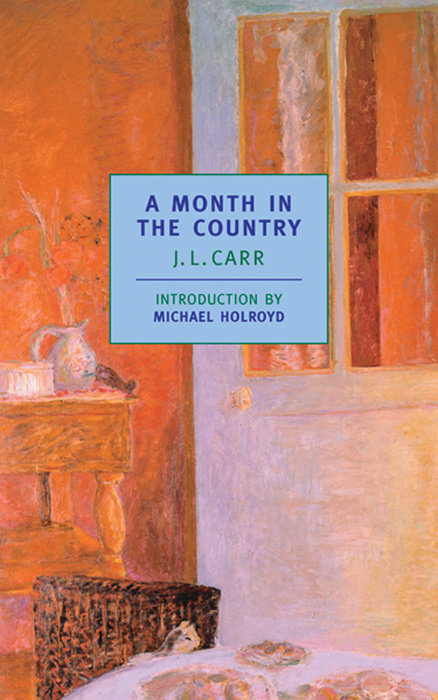
So to another book I found in the same shelf: J.L. Carr’s A Month in the Country

I had known this book was meant to be rather good and had been planning to read it for years, but would likely have gone on doing so had I not found a copy in my friend’s bookcase. I am glad I did. Carr wasn’t a well-known or fashionable writer; he spent much of his life as a teacher in Kettering and wrote books because he felt like it. They attracted little notice until he was really quite old. But this short book, written in the late 1970s when he was about 66, is a tour de force.

A Month in the Country begins on a wet day in the summer of 1920. A young man arrives in the Yorkshire village of Oxgodby to execute a commission. A wealthy parishioner has left a bequest to the church on the condition that a medieval doom-painting high on the chancel arch, long whitewashed over, is uncovered. The young man, Birkin, is the restorer. Over the summer he will reveal the painting. He will also find a sense of peace in the village, and will start to recover from the damage inflicted on him on the battlefield at Passchendaele. But he will also fall in love, and face a decision. Nearly 60 years later, he recounts that summer in Yorkshire and what it meant to him, and remembers the world of the 1920s, now vanished.

I had expected a dreamy, elegiac book, but it seemed at first that I was going to get something more realistic than that. It opens in the rain as Birkin walks down to Oxgodby soaked to the skin and gets a cool welcome from the vicar, who he knows at once he shan’t like. And yet this book is elegiac, a picture of the countryside 100 years ago and a way of life that has likely largely gone, with horses and carts hauling people to Sunday-school treats and harmoniums in the chapels. This could have been very hackneyed or contrived, or come across as cloying nostalgia. It doesn’t, because Carr’s language is simple and elegant; not one passage is over-written, so that at the end the sense of a lost world, and long-ago love, strikes one suddenly and with some force. It’s something I’ve only seen done this well once before, by J. B. Priestley in his own masterwork, Bright Day.


A Month in the Country
does have a harder edge, should one wish to find it. Medieval doom paintings were intended to warn the congregation of damnation. The righteous are shown lining up to enter Heaven; sinners are seen falling into hellfire, assisted by imps and demons. I wondered if Carr intended to link the depiction of Hell in the painting, and the fact that Birkin, along with millions of other young men, had just been there. Is Carr telling us that Christian notions of Hell are somewhat idle when it’s actually a place that we create ourselves? Carr was eight in 1920, so did not fight in the First World War (though he did serve in the Second). But he would certainly have remembered the shadows the war cast in the 1920s. My father, born in 1920, did. 

Meanwhile there is a hint that whoever painted the original may have died suddenly, before he could finish his work; also that one of the damned souls in his painting is clearly someone real. These two facts may be linked, but Carr leaves this to our imagination. But it doesn’t really matter whether one uncovers these layers or not, because this short, simply written and rather beautiful book has enormous impact. I can’t recommend it too highly. In fact A Month in the Country and To the Lighthouse may both be amongst the four or five best novels I have read.

Sometimes books can be a source of solace at a time of change and worry. These two were.


If you liked this…

More from the haunted wing of 20th century literature

The Butler Did It! ...Or Did He?
Who, really, were the Queens of Crime? A look back at Agatha Christie, Dorothy Sayers and their rivals

The Monkey’s Benison: Rumer Godden and Imperial India
A novelist, best known for Black Narcissus – but  who also wrote dazzling memoirs

Diana Athill: Self-Scrutiny, and the Writer’s World
An editor and writer who held up a mirror to herself, and to the human condition

Crime on the Side
The oddest people moonlight as crime writers – and sometimes they’re rather good. A famous journalist and a Poet Laureate were among them

If not us, who? If not now, when?
Courage and tragedy at the heart of the Third Reich

On Whether He Warned Us
The long, fatal journey of Stefan Zweig

When the Best Lack All Conviction
Two women who didn’t: Rachel Corrie and Heather Campbell

War Tour: The Incredible Journey of Ève Curie
Marie Curie’s youngest daughter did not – quite – win a Pulitzer. But she left a compelling account of World War Two and the people who fought it

The Great War in Modern Voice
Written nearly 60 years after the war ended, Eric Hiscock’s The Bells of Hell has a life and freshness that you won’t find in the classic memoirs

Around the Horn Before the Mast
Jack London, Alan Villiers, Eric Newby: Great books from the last days of sail

Screw the Donah’s Groinies
A likeable romp through the fairgrounds of prewar Britain

Before Yossarian
Two powerful books from the First World War

And an incursion into the 21st century…

To Pagford, from Bradford
J.K. Rowling’s first post-Potter, The Casual Vacancy, divided the critics; but what mattered was what it tells us about ourselves. Two novels that shone a light on Britain in 2013 – and in 1913

Love in the Time of Brexit
The 2016 Brexit referendum divided Britain along class lines. Why? Two shrewd, gripping novels on Brexit, class and the dynamics of division


Read some of Mike's own fiction here

Mike is now also on Substack at https://mikerobbinswrites.substack.com/

Mike Robbins’s latest book, On the Rim of the Sea, is now 
available as a paperback or ebook. More details here.


Monday, 16 May 2022

On the Rim of the Sea

 Enjoy the sea view. Don’t fall in

At the end of 2012 I started this blog. I don’t know quite what I planned to do with it at the time. The heading says “Travel, science, books Whatever I feel like, really.” Which is more or less how it’s panned out. It’s been an eclectic mess of pieces covering everything from lentil recipes to politics. (Quite a lot of politics, actually.)


I realized that some of the pieces were beginning to fit a pattern. I would become interested in some topic or event, and gather books about it – then use them to write a piece on that particular subject, examining the different angles and accounts. I don’t think this format was a new idea. Punch did this in its book-review pages when I was growing up and I believeThe New Yorker has also done so. It lets you swoop down upon some incident or time that has piqued your curiosity. 

In my case, they included such varied topics as the philosophy of science, the world’s worst shipwreck (no, not the Titanic), the postwar occupation of Germany, the extraordinary life of Marie Curie’s daughter Ève, the fate of Chinese labourers on the Western Front, the way novelists have seen Fleet Street, a writer’s memoirs of Imperial India, the last great sailing ships, and the Golden Age of crime fiction.

At some point I saw that, strung together in the right order, the pieces would be a review of the 20th century through its memoirs and literature. At that point my new book, On the Rim of the Sea, began to take shape.

The book’s title was inspired by a passage in the splendid Instead of a Letter, by the late Diana Athill. In it she describes how, as a child, she shocked her grandmother by talking of life as being in a bowl, floating on the sea; provided one stayed at the bottom of the bowl, one might be serene – but every now and then the motion of the sea flung one up the side and forced one to a view of “dangerous, cold grey water” that would be unbearable. That, she said, was the origin of madness. Is it? The years covered by the pieces in this book (roughly, 1912 to the present) certainly showed us more of the sea than we should have liked. As I write (May 2022), the cold grey water is back with a vengeance. But it has not always been that way. This book has its darker bits, but there were lighter times.

This book is, in part, a self-indulgence – I acknowledge that freely; it’s the result of years spent reading books on a whim. But there is also a purpose. The books of a time, especially its memoirs and reportage, do hold up a mirror to a period or incident when it has long passed. I’d strongly disagree with the critic Cyril Connolly, who wrote in The Unquiet Grave (1944) that: '"The more books we read, the sooner we perceive that the true function of a writer is to produce a masterpiece and that no other task is of any consequence." This is, frankly, bullshit. Most writers will not produce a masterpiece and they don’t always aspire to. Rather, they provide a lens through which others can better see the world. This is not always an art; quite often, it is just a craft.

If On the Rim of the Sea shines a light on unfamiliar corners of the past century, I shall be happy. If its readers enjoy it, I shall be very happy indeed.


Where to buy On the Rim of the Sea

The book is available as both an ebook and a paperback. If you’d like to support independent bookshops (as many people do), they can order it; you will need the ISBN number (978-0991437481).

To buy online:

Amazon (or in the UK, here)

Apple Books

Barnes & Noble/Nook

BetterWorldBooks

Booktopia (Australia)

Waterstones

Rakuten Kobo

Scribd

Mike is now also on Substack at https://mikerobbinswrites.substack.com/